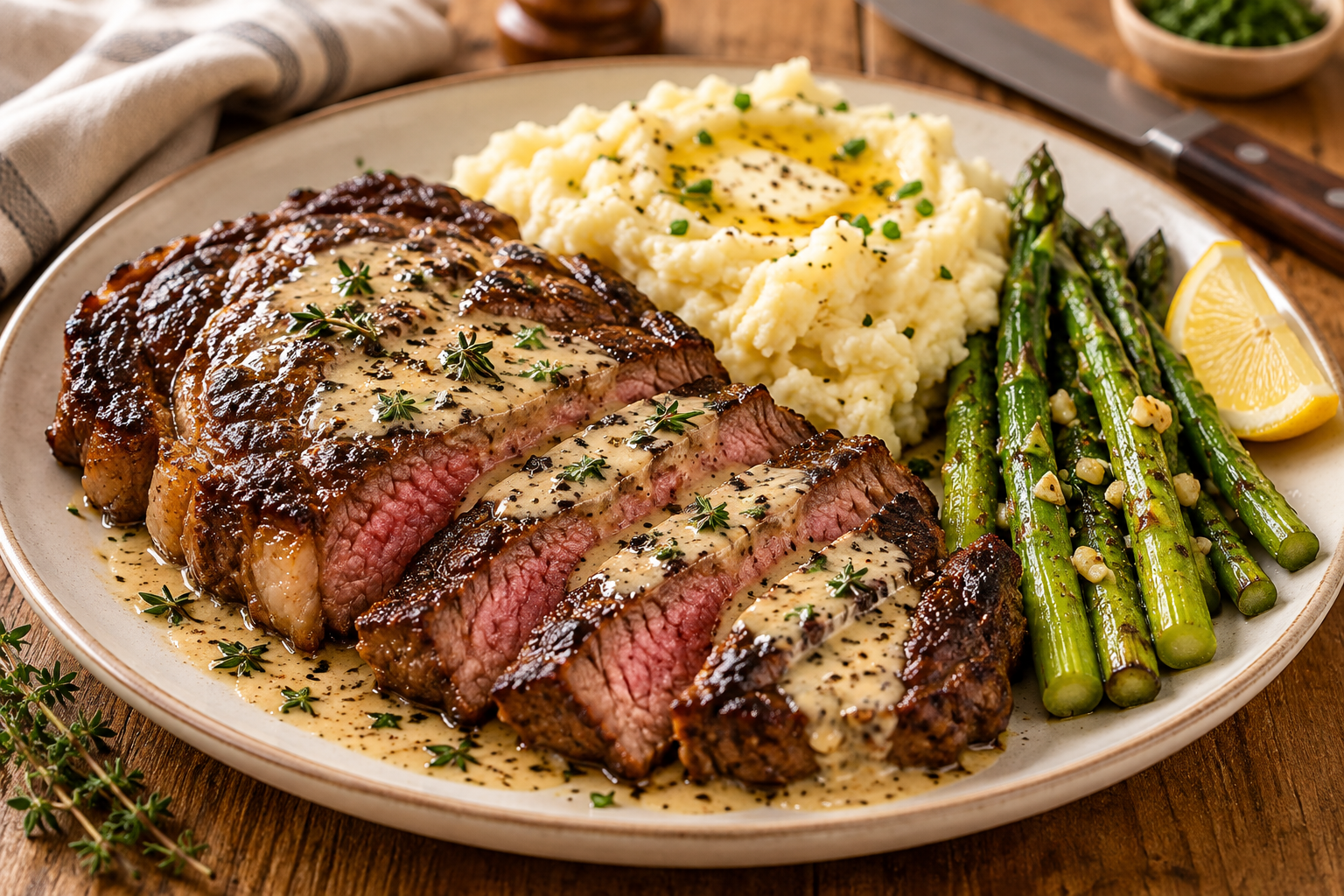
A great steak dinner usually goes wrong in the timing, not the cooking. The steak needs a hot pan and a rest, the potatoes have to stay warm and creamy, and asparagus goes from crisp to limp in about a minute. This recipe solves that with a clear order of operations. You’ll sear the steaks, build a creamy pan sauce in the same skillet using the browned bits, mash Yukon Gold potatoes until silky, and sauté garlic asparagus while the meat rests. It serves four, uses no wine or alcohol, and comes together in about 50 minutes.
Why You’ll Love This Recipe
- A full dinner from one plan. The steps are ordered so the steak, sauce, potatoes, and asparagus all finish together.
- Restaurant-style sauce, no wine needed. Beef broth, shallot, Dijon, and cream build real depth without any alcohol.
- The sauce uses the pan. The browned bits left after searing (called fond) carry the flavor, so there’s nothing extra to buy.
- Familiar ingredients. Everything is available at a regular grocery store.
- Easy to scale. Cook two steaks in a smaller skillet and halve the sides, or keep the full amounts for a crowd.
Ingredients You’ll Need
The full measurements are in the recipe card. Here is what each part does, so you can shop and swap with confidence.
The steak. Ribeye and New York strip are the easiest picks because they have enough fat to sear well and stay juicy. Look for steaks about 1 to 1¼ inches thick. Thinner steaks overcook before they brown. Top sirloin works too and is leaner.
The sauce. Shallot and garlic give it a sweet, savory base. Beef broth supplies the meaty flavor, and Dijon mustard and Worcestershire sauce add tang and depth. Heavy cream makes it silky and gives it body. A little thyme and a squeeze of lemon keep it from tasting heavy.
The mashed potatoes. Yukon Gold potatoes have a naturally buttery texture and a medium starch level, so they mash smooth without turning gluey. Warm milk and butter go in at the end, and a spoonful of sour cream adds a gentle tang.
The asparagus. Medium-thick spears hold up best to a quick sauté. Very thin spears can overcook in seconds. Garlic goes in near the end so it stays sweet instead of bitter.
How to Make Steak with Creamy Pan Sauce, Mashed Potatoes & Garlic Asparagus
The full step-by-step is in the recipe card. This is the order that keeps everything hot, and it’s the part most recipes skip.
- Take the steaks out of the fridge first. Let them sit at room temperature for about 30 minutes, then pat them very dry and season generously. Dry meat sears. Wet meat steams.
- Start the potatoes next. They take the longest, about 18 to 22 minutes from a cold-water start. Starting in cold salted water cooks them evenly.
- Prep the asparagus and sauce ingredients while the potatoes simmer. Mince the shallot and garlic, measure the broth and cream, and trim the asparagus.
- Sear the steaks. Use a heavy skillet over medium-high heat. Cook without moving them so a deep brown crust forms, then flip once. Add a little butter at the end and spoon it over the top.
- Rest the steaks. Move them to a plate and let them rest for at least 5 minutes. This keeps the juices in the meat, and it’s also your window to make the sauce.
- Make the sauce in the same skillet. Pour off excess fat, soften the shallot and garlic, and add the broth. Scrape up the browned bits. Reduce, then stir in the cream, mustard, and Worcestershire until the sauce coats the back of a spoon.
- Mash the potatoes while the sauce simmers. Drain well, then mash with butter, warm milk, and sour cream.
- Sauté the asparagus in a second pan for just 4 to 5 minutes with garlic, and finish with lemon.
- Plate everything. Slice the steak against the grain, spoon the sauce over the steak and potatoes, and serve right away.
Expert Tips for Best Results
- Use a meat thermometer. It is the most reliable way to hit your preferred doneness. Pull the steak a few degrees below your target, because the temperature keeps rising while it rests.
- Get the pan properly hot. The oil should shimmer before the steak goes in. A pale, gray steak almost always means the pan wasn’t hot enough or the steak was wet.
- Don’t crowd the skillet. If four steaks won’t fit with space between them, sear in two batches and keep the first ones tented with foil.
- Warm the milk for the mash. Cold milk cools the potatoes and makes them harder to mash smoothly.
- Don’t overwork the potatoes. Mash by hand or with a ricer. A blender or food processor breaks down the starch and makes them gummy.
- Keep the sauce at a gentle simmer. A hard boil can cause cream sauces to separate.
Steak doneness guide
Remove the steak from the pan at the “pull” temperature, then let it rest. The USDA recommends cooking whole cuts of beef to a safe minimum internal temperature of 145°F, followed by a 3-minute rest. Lower temperatures are a personal preference, so choose what you’re comfortable serving.
| Doneness | Pull at | Final temperature after rest |
|---|---|---|
| Medium-rare | 125–130°F | 130–135°F |
| Medium | 135–140°F | 140–145°F |
| Medium-well | 145–150°F | 150–155°F |
Troubleshooting
- Sauce too thin: simmer a few more minutes, stirring, until it coats a spoon.
- Sauce too thick: whisk in a splash of broth or warm water.
- Sauce looks split or greasy: take it off the heat and whisk in a spoonful of cold cream or broth.
- Sauce tastes flat: add a pinch of salt and a few drops of lemon juice.
- Gummy potatoes: this usually means they were overmixed or mashed in a machine. Next time, mash gently by hand.
Variations and Substitutions
- Mushroom pan sauce: sauté sliced cremini mushrooms in the skillet before adding the shallot.
- Peppercorn version: add 1 teaspoon of coarsely cracked black pepper to the sauce.
- Lighter sauce: use half-and-half in place of heavy cream, and simmer it gently so it doesn’t curdle.
- Different steak cuts: try sirloin, filet mignon, or bone-in strip. Thicker cuts need a longer cook time and are best checked with a thermometer.
- Different potatoes: Russets give a fluffier mash that absorbs more butter. Red potatoes give a denser, rustic texture.
- Roasted asparagus: toss the spears with oil and roast at 425°F for 8 to 10 minutes instead of sautéing.
- Dairy-free mash: use olive oil and unsweetened plant milk in place of the butter and milk, though the flavor will be different.
What to Serve With Steak with Creamy Pan Sauce
This is already a complete plate, so a little contrast goes a long way. Warm dinner rolls are good for mopping up the sauce. A simple green salad with a sharp vinaigrette cuts through the richness. If you want another vegetable, roasted carrots or green beans fit well. For dessert, keep it light with fresh berries or a lemon tart.
Storage and Reheating
- Refrigerate promptly. Get leftovers into airtight containers within 2 hours of cooking. Store the steak, sauce, potatoes, and asparagus separately for the best texture, and use them within 3 to 4 days.
- Reheat to 165°F. USDA guidance for leftovers is to reheat to 165°F.
- Steak: slice it and warm it gently in a skillet with a spoonful of sauce so it doesn’t dry out. It will be more cooked than when you first served it.
- Sauce: reheat over low heat, whisking, and add a splash of broth or milk if it thickened.
- Mashed potatoes: warm them in a saucepan or the microwave with a splash of milk, stirring in between.
- Asparagus: it’s best fresh. Leftovers will be softer, but they are fine for a day or two in a quick skillet reheat.
- Freezing: I don’t recommend freezing the cream sauce or the asparagus, because the texture suffers.
Frequently Asked Questions
What is the best steak for this recipe?
Ribeye and New York strip are the easiest to cook well because their fat keeps them juicy and flavorful. Top sirloin is a leaner, more budget-friendly option.
Can I make the pan sauce without wine?
Yes. This version uses beef broth, Dijon mustard, and Worcestershire sauce for depth, and no alcohol at all.
How do I know when the steak is done without a thermometer?
Touch tests and timing are unreliable, especially with different thicknesses and cuts. An instant-read thermometer is inexpensive and takes the guesswork out, so it’s worth having for steak.
Can I make any of this ahead?
The mashed potatoes can be made up to a couple of hours ahead and kept warm in a covered pot over very low heat, with a splash of milk stirred in before serving. The steak and the asparagus are best cooked right before serving.
Why does the steak need to rest?
Resting lets the juices redistribute through the meat. If you slice too soon, more of that liquid ends up on the board instead of in each bite.
Final Thoughts
With a good sear, a short rest, and a sauce built in the same pan, this meal feels like a restaurant dinner without the guesswork. Once you’ve got the timing down, it’s easy to repeat for a weeknight treat or a special occasion.
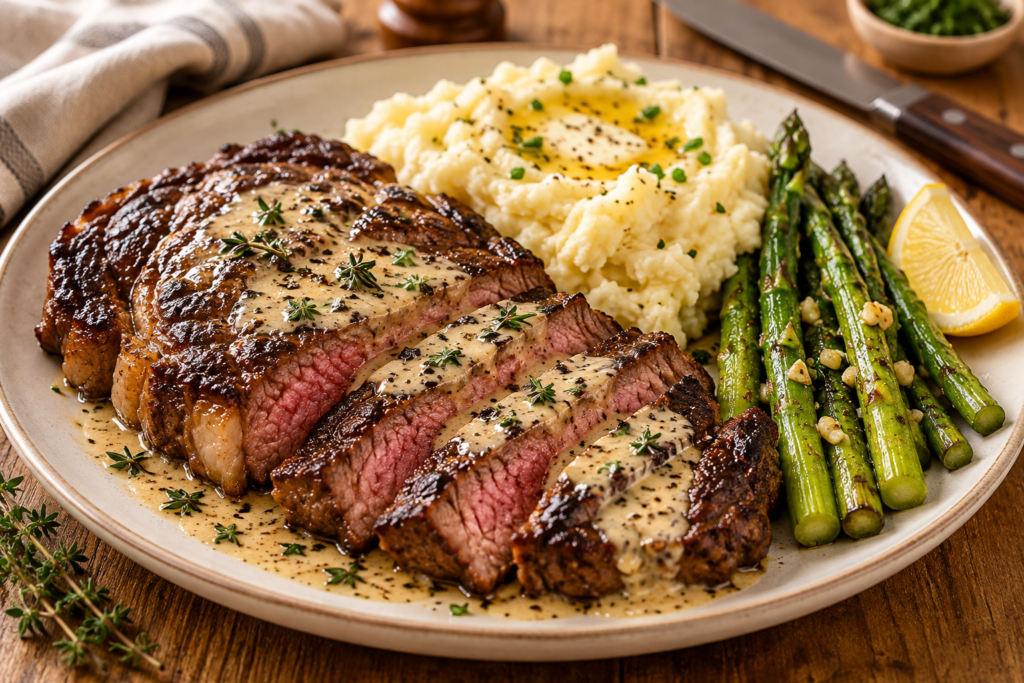
Steak with Creamy Pan Sauce, Mashed Potatoes & Garlic Asparagus
Pan-seared steak with a silky cream sauce made in the same skillet, buttery Yukon Gold mashed potatoes, and garlic asparagus. A complete steak dinner for four.
Ingredients
Instructions
- Take the steaks out of the refrigerator about 30 minutes before cooking. Pat them very dry with paper towels, then season both sides with 1 1/2 teaspoons salt and 1/2 teaspoon pepper.
- Place the potatoes in a large pot and cover with cold water by about 1 inch. Add 1 tablespoon salt and bring to a boil over high heat. Reduce to a steady simmer and cook 18 to 22 minutes, until a knife slides through the potatoes with no resistance.
- While the potatoes cook, mince the shallots and garlic, measure the broth, cream, mustard, and Worcestershire, and trim the asparagus.
- Heat the oil in a large heavy skillet over medium-high heat until it shimmers. Add the steaks without crowding and cook about 3 to 4 minutes without moving them, until deeply browned. Flip and cook 3 to 4 minutes more for medium-rare, adjusting for thickness. Add 1 tablespoon butter to the pan during the last minute and spoon it over the steaks.
- Use an instant-read thermometer to check doneness. Pull the steaks at 125 to 130 degrees F for medium-rare, 135 to 140 degrees F for medium, or 145 to 150 degrees F for medium-well. The USDA safe minimum for whole cuts of beef is 145 degrees F with a 3-minute rest.
- Transfer the steaks to a plate and rest for at least 5 minutes. Keep the skillet and its browned bits on the stove.
- Pour off all but about 1 tablespoon of fat from the skillet. Reduce heat to medium, add 1 tablespoon butter, then the shallots, and cook 2 minutes until softened. Add 3 cloves garlic and the thyme and cook 30 seconds.
- Add the beef broth and scrape up the browned bits from the bottom of the pan. Simmer 4 to 5 minutes, until reduced by about half. Stir in the cream, Dijon, and Worcestershire and simmer gently 3 to 4 minutes, until the sauce coats the back of a spoon. Stir in any resting juices from the steaks. Add lemon juice and salt and pepper to taste.
- Drain the potatoes well and return them to the warm pot. Mash with 4 tablespoons butter, the warm milk, sour cream, 1/2 teaspoon salt, and 1/4 teaspoon pepper until smooth. Cover to keep warm.
- Heat the olive oil and 1 tablespoon butter in a large skillet over medium-high heat. Add the asparagus and 1/4 teaspoon salt and cook 4 to 5 minutes, turning occasionally, until bright green and crisp-tender. Add 3 cloves garlic during the last minute. Finish with a squeeze of lemon.
- Slice the steaks against the grain. Divide the mashed potatoes, asparagus, and steak among plates, spoon the sauce over the steak and potatoes, and sprinkle with chives. Serve immediately.
Recipe Notes
Use steaks about 1 to 1 1/4 inches thick for the best sear. Dry the steaks well and use a hot pan. Keep the sauce at a gentle simmer so it does not separate. Mash potatoes by hand or with a ricer, not a blender. Refrigerate leftovers within 2 hours and reheat to 165 degrees F. Store the components separately for the best texture, and use within 3 to 4 days.